Sourcing bagasse tableware from China is tough. Countless factories all look the same. I’ll share key secrets to help you choose the right partner, avoiding costly mistakes.
To choose a reliable sugarcane bagasse supplier in China, look beyond price. Prioritize verified product quality (water/oil proof), essential compostability certifications like BPI1 or OK Compost, and ensure your supplier uses high-grade, pure raw material. This ensures a reliable partnership.
Choosing the right partner is more than just ticking boxes. It's about finding a factory that understands your needs and can grow with you. In my years experience at Webester Eco Pack2, I've seen many businesses make the same few mistakes. Let's break down what truly matters so you can make a confident choice. It's not as complicated as it seems, but you need to know where to look.
Is product quality still the most important factor?
Everyone claims 'high quality,' but what does it mean? You worry about getting flimsy containers that leak or can't handle heat. Let's define what real quality looks like for bagasse tableware.
Absolutely. Quality is non-negotiable. Your supplier must guarantee products are waterproof3, oil-proof4, and can handle both hot and cold foods without losing shape. This is the foundation of customer satisfaction and your brand's reputation. Never compromise on these fundamental performance tests for a lower price.

In an industry where many factories compete on price, quality can sometimes be the first thing to suffer. But for your business, it must always be the first priority. When I talk about quality, I'm not just talking about how the product looks. I'm talking about its core performance. Imagine a customer's meal leaking through a container or a plate becoming soggy and collapsing. That's a disaster for your brand.
Here at Webester Eco Pack2, we focus on these essential quality checkpoints. A reliable product must perform under real-world conditions. Before you commit to a supplier, you should always ask for samples and test them yourself.
Key Quality Tests
| Test | Why It's Important | What to Look For |
|---|---|---|
| Waterproof | Prevents leaks with soups, sauces, or dressings. | Fill with water for several hours; check for sogginess or leaks. |
| Oil-proof | Crucial for fried or oily foods. | Test with hot oil; the material should not weaken or soak through. |
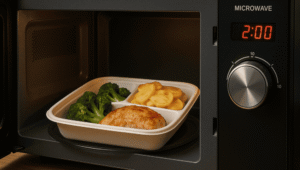
| Heat-Resistant | Must be safe for microwaves and hold hot food. | Microwave a sample with food; it should not deform or release smells. |
| Cold-Resistant | Needs to be sturdy enough for refrigeration or freezing. | Freeze a sample; it should not become brittle or crack. |
A good supplier isn't afraid to prove their quality. We know our products stand up to these tests because we use raw materials and have strict quality control5 throughout our 10+ production lines. This is the baseline for a successful partnership.
What certifications should your bagasse supplier have?
You've found a supplier with great quality, but how do you prove their products are truly eco-friendly? Without official certifications, your environmental claims6 are just empty words.
Your supplier must hold internationally recognized compostability certifications. Look for BPI1 for the North American market and OK Compost (HOME or INDUSTRIAL)7 for Europe. These verify that the products will actually break down as promised, which is essential for market access and credibility.
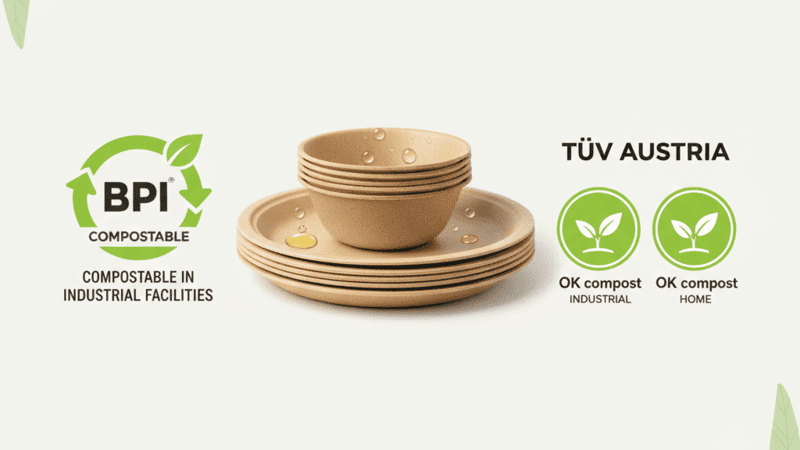
Certifications are your proof. They are independent, third-party verifications that confirm a product meets specific standards for safety and environmental performance. In the eco-friendly packaging world, this is not a 'nice-to-have'; it's a requirement. If you want to sell in markets like Europe or North America, or supply to customers who care about sustainability, you need to show them the proof. Many distributors and retailers won't even consider a product without the right certifications.
Over the years, I've made sure Webester Eco Pack4 has secured all the key global certifications. It's an investment, but it shows our commitment to quality and transparency. It gives our partners confidence. When you're evaluating a supplier, don't just take their word for it. Ask to see the certification documents.
Essential Certifications to Ask For
| Certification | Region | What It Guarantees |
|---|---|---|
| BPI1 | North America | The product is certified to be compostable in industrial composting facilities. |
| OK Compost HOME | Europe / Global | The product can be composted in a backyard compost bin. |
| LFGB8 & EC 1935/2004 | Europe | The material is safe for food contact according to strict European standards. |
| FDA9 | USA | The material is safe for food contact according to U.S. standards. |
| BRCGS | Global | The manufacturing facility meets global standards for packaging material safety. |
These aren't just logos to put on a box. They are your ticket into serious markets and your defense against claims of greenwashing. A supplier who has invested in these is a supplier who is serious about their business and yours.
How can I avoid suppliers who cut corners on materials to win price wars?
You get a quote that's much lower than others. It feels suspicious, and you want the deal, but you're worried. I'll show you how to spot suppliers who cheat on materials.
To avoid this, ask for a material composition data sheet. Inquire directly if they use 100% virgin sugarcane bagasse10 or if they mix in other fillers like wood pulp or recycled content. Always request and test samples yourself. An unusually low price is the biggest red flag.
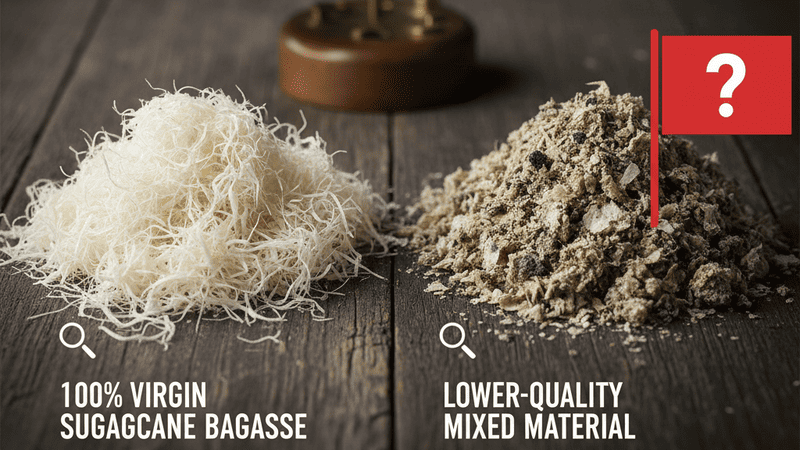
In the highly competitive Chinese market, the temptation to lower prices by any means necessary is strong. The most common way some factories do this is by adulterating their raw materials. Since pure, high-quality bagasse is the most significant cost, they will mix in cheaper fillers to reduce the price per unit. Our entire company mission is built on the idea of "Turn Waste into Value." We use 100% pure sugarcane by-product, a waste material from the sugar industry. Diluting this with other materials betrays that mission and, more importantly, cheats the customer.
The "Too Good to Be True" Price
If you get five quotes and one is 20% lower than the rest, don't celebrate. Be suspicious. That cost saving has to come from somewhere. It's almost always from the raw material. They might be using wood pulp, bamboo pulp, or even recycled paper pulp. This creates serious problems.
What to Ask and What to Test
You need to be direct. Don't be afraid to ask pointed questions.
- Ask for a spec sheet: "Can you provide a technical data sheet that confirms the material is 100% sugarcane bagasse?"
- Ask directly: "Do you mix any other pulp, like wood or bamboo, into your bagasse products?"
- Request samples: Get samples and test them yourself. Pure bagasse products have a distinct feel and color. Mixed-material products often feel softer, less rigid, and can have an off-white or greyish tint.
Here’s a comparison of what you’re getting:
| Feature | 100% Virgin Bagasse | Mixed / Low-Grade Material |
|---|---|---|
| Strength | Sturdy, holds up to heat and liquids | Can be weaker, may get soggy |
| Color | Natural white or light beige | Often greyish or has specks |
| Safety | Certified food-safe | Unknown, potential contaminants |
| Compostability | Certified compostable | Will not break down properly |
Protect your business and your customers by insisting on material purity. A slightly higher price for a guaranteed pure product is a far better investment than a cheap product that fails.
Conclusion
Choosing the right supplier means looking past the price. Focus on quality, verify certifications, and material purity to build a truly reliable and sustainable business partnership.
Explore this link to understand BPI certification, essential for verifying eco-friendly claims and market access. ↩
Learn more about Webester Eco Pack, an expert in making sugarcane bagasse tableware. ↩
Find methods to ensure your packaging is truly waterproof, preventing leaks and maintaining quality. ↩
Learn about essential tests that guarantee your packaging can handle oily foods without compromising quality. ↩
Discover effective quality control practices that can enhance your product reliability. ↩
Learn how to back up your environmental claims with certifications and testing. ↩
Understanding OK Compost certifications is crucial for ensuring your products meet eco-friendly standards and market requirements. ↩
Understanding LFGB is crucial for ensuring your products meet Germany's and Europe's rigorous standards, ensuring they are safe for contact with food and have been tested for chemical migration, odors, and taste. ↩
Expolore this link to understand FDA standard and certification. ↩
Learn what is sugarcane bagasse and how are bagasse plates are made. ↩